
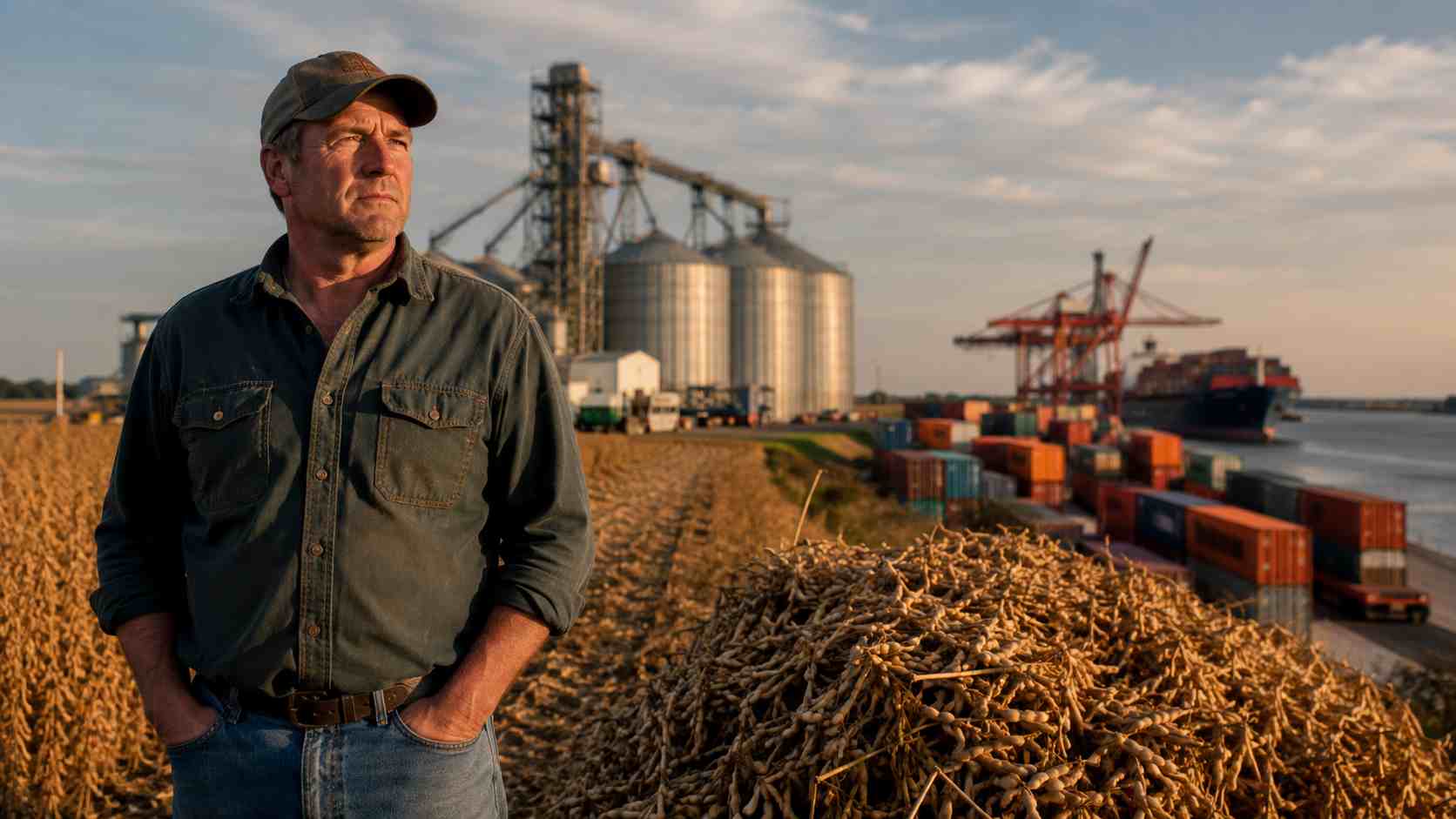
China farm purchases are again the fastest visible test of whether the latest Trump-Xi trade diplomacy can produce a concrete result for U.S. agriculture.
After a summit in Beijing on May 15, 2026, U.S. Trade Representative Jamieson Greer said Washington expects China to commit to annual purchases of U.S. agricultural products worth “double-digit billions” over a three-year period.
Greer described the expected package as broader than soybeans, while still pointing to soybeans as the anchor commodity. The distinction matters because a headline buying target can move markets quickly, but farmers, grain traders, exporters and processors need to know whether China is adding fresh demand or mostly restating commitments already on the table.
Context
Agriculture has been a recurring pressure point in U.S.-China trade talks because China is a large buyer of global soybeans and because U.S. farmers are highly exposed to export swings. The White House said after an earlier 2025 trade understanding that China would buy at least 12 million metric tons of U.S. soybeans in the final two months of 2025 and at least 25 million metric tons in each of 2026, 2027 and 2028.
That earlier baseline is now central to the market debate. Greer referenced the 25 million metric ton annual soybean level, which he said was valued at more than $10 billion. If the new farm package is built on top of that baseline, it could improve U.S. export prospects. If it mainly repackages that baseline, the practical market impact may be smaller than the political headline.
Mechanism
A farm-purchase commitment works through contracts, state-directed buying, private-sector purchases, tariff treatment and shipping schedules. China can signal support for U.S. crops, but actual flows depend on whether importers find U.S. supplies competitive against Brazilian and other origins.
That is why traders are watching more than the dollar number. They are also watching whether China changes tariff treatment or other measures that affect private buyers. A government-level pledge can create a target, but private importers still weigh price, freight, currency, crushing margins, inventory needs and policy risk.
Stakeholders
The most immediate beneficiaries of a credible increase would be U.S. soybean growers, grain handlers, exporters and river and port logistics companies. Corn, sorghum, wheat, cotton, meat, dairy, fruit and other farm sectors could also benefit if the package truly includes a wide set of agricultural goods.
China’s buyers face a different calculation. They want reliable supply, competitive prices and room to shift sourcing when Brazil, the United States or other exporters offer better terms. Beijing also has an incentive to show trade progress without making commitments that leave Chinese companies paying above-market prices.
Data and Evidence
The clearest number in the discussion is the existing soybean reference point: 25 million metric tons per year through 2028. That would be a significant flow, but it does not automatically prove new incremental demand.
Independent agricultural analysis has noted that a 25 million metric ton annual level would still be below recent longer-run averages of U.S. soybean shipments to China. Purdue University agricultural economists estimated in November 2025 that 25 million metric tons would be about 14 percent below the 2020-2024 five-year average of 29 million metric tons.
USDA’s April 2026 soybean market outlook also underscored the competitive pressure from Brazil. USDA said the U.S. soybean export forecast for marketing year 2025/26 was reduced to 1.54 billion bushels, citing higher soybean exports from Brazil.
Analysis
The strongest explanation is that Washington is trying to turn the summit into a measurable trade deliverable for farm states. A multiyear dollar commitment gives U.S. officials a number they can point to quickly, while leaving room to negotiate product mix and timing.
For markets, the harder question is whether the deal changes the real balance sheet. If China’s total import needs are unchanged, extra U.S. buying may simply displace Brazilian cargoes or shift buying between seasons. If China removes barriers and private buyers return at scale, the effect would be stronger because it could improve basis levels, export inspections and sales momentum.
Counterpoint
The counterpoint is that officials have not yet provided a fully public, detailed schedule showing what China will buy, when it will buy it, and whether the volumes are additional to prior commitments. Treasury Secretary Scott Bessent’s comment that soybeans were “all taken care of” cooled expectations that a large new wave of soybean purchases was imminent.
There is also uncertainty on China’s side. Beijing has not publicly confirmed every U.S. description of earlier soybean targets, and trade commitments can be interpreted differently across calendar years, crop years and delivery windows.
Consequence
The consequence is a split between political value and commercial value. Politically, a “double-digit billions” annual farm-purchase framework gives the administration a clear message to farmers and exporters after the summit.
Commercially, the value depends on execution. Farmers will care less about the headline number than about export sales, vessel loadings, cash bids and whether China’s importers are active buyers without needing constant government direction.
What to Watch
The next signals will be any written U.S.-China document, Chinese confirmation of the package, USDA daily export sales announcements, tariff or exclusion changes, and the mix of crops included beyond soybeans.
Markets will also watch whether purchases arrive quickly enough to affect the current marketing year. The uncomfortable truth is that a managed buying pledge can support confidence, but only shipped cargoes and confirmed sales change the farm-income math.
Sources
Sources = US expects 'double-digit billions' in Chinese farm purchases after Trump-Xi summit, says Greer — Reuters — May 15, 2026
Sources = US's Bessent says soybeans 'all taken care of', cooling expectations for fresh Chinese buying — Reuters — May 14, 2026
Sources = Fact Sheet: President Donald J. Trump Strikes Deal on Economic and Trade Relations with China — The White House — November 1, 2025
Sources = Soybeans and Oil Crops - Market Outlook — USDA Economic Research Service — April 14, 2026
Sources = U.S.-China Soybean Deal: Comparing Past Export Levels and Global Market Impacts — Purdue University Center for Commercial Agriculture — November 14, 2025