
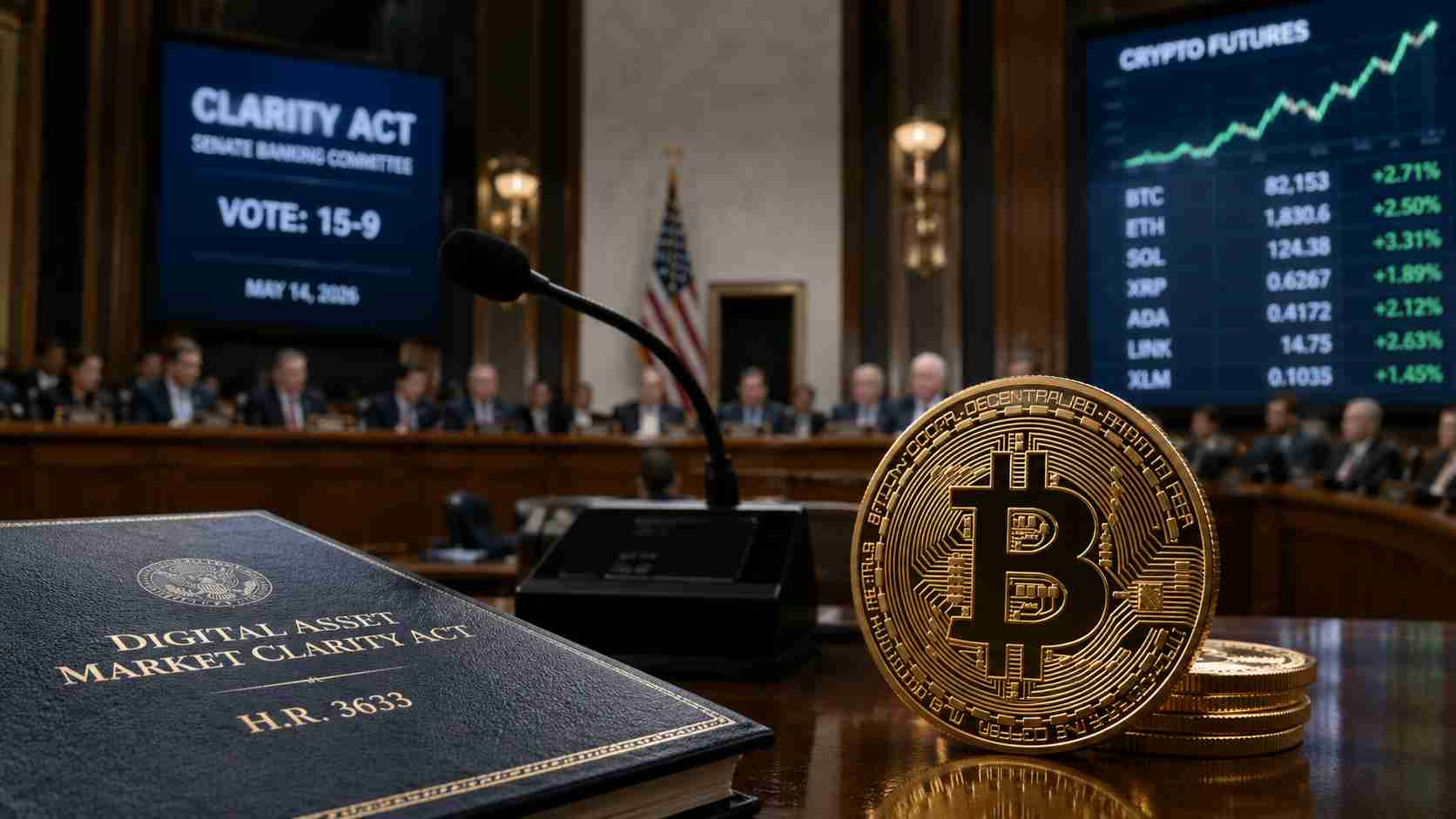
CLARITY Act momentum became the clearest catalyst for the latest crypto-market bid after the U.S. Senate Banking Committee advanced H.R. 3633, the Digital Asset Market Clarity Act of 2025, on May 14, 2026.
The committee vote moved the bill toward the full Senate and gave traders a fresh regulatory headline to price. Bitcoin traded back around the low-$80,000 range, while crypto-linked equities, including Coinbase, drew attention as investors reassessed the chance of a clearer U.S. rulebook.
The move was not only about one bill. CME Group also announced plans to launch Nasdaq CME Crypto Index futures on June 8, pending regulatory review, and 21Shares showed a new actively managed U.S. crypto ETF under the ticker TKNS. Together, the developments pointed to a market where regulation, futures infrastructure and ETF wrappers are becoming more important than hype alone.
Context
For years, U.S. crypto markets have operated under a split regulatory structure in which the Securities and Exchange Commission and Commodity Futures Trading Commission have often been central to disputes over token classification and trading oversight.
The CLARITY Act is designed to define when digital assets should be treated as securities, commodities or otherwise. Reuters reported that the bill advanced with support from all committee Republicans and two Democrats, although some Democrats warned they may not support the final version on the Senate floor.
That distinction matters. A committee vote is progress, not law. The bill still needs full Senate approval, alignment with the House process and final enactment before it can reshape market rules.
Mechanism
The market reaction followed a familiar crypto pattern: when regulatory uncertainty appears to narrow, liquidity tends to move first into Bitcoin and the most institutionally visible names.
Bitcoin benefits from depth, brand recognition and the reserve-asset narrative inside crypto markets. When traders see a policy path opening, they often use Bitcoin as the first expression of the trade because it is easier to enter, exit and hedge than smaller tokens.
That helps explain why regulatory headlines can lift overall sentiment without automatically producing a broad altcoin rally. A clearer rulebook may eventually help exchanges, custodians, market makers and token issuers, but the first market reaction often favors the most liquid assets and listed crypto equities.
Stakeholders
Crypto exchanges and trading platforms are the obvious beneficiaries if legislation reduces legal ambiguity. Coinbase and similar firms stand to gain if market-structure rules make it easier to list, trade and custody digital assets under a more predictable regime.
Traditional financial firms also have a stake. CME’s planned Nasdaq CME Crypto Index futures would give professional investors a single futures product tied to a market-cap weighted crypto basket, rather than forcing them to manage separate single-token exposure.
Banks remain pressured by parts of the debate, especially around stablecoin rewards and the risk that crypto firms could compete with deposit products. Lawmakers who supported the bill argue that clearer rules can protect consumers and keep activity inside the U.S.; critics say the framework may still need stronger anti-money-laundering and ethics provisions.
Retail investors are exposed to both sides. More products can improve access and transparency, but they can also make it easier for ordinary buyers to take risk they may not fully understand.
Data and Evidence
The Senate Banking Committee said the CLARITY Act advanced by a 15-9 vote on May 14, 2026, and now moves to the Senate floor. Reuters separately reported that two Democrats joined Republicans in advancing the bill, while also noting that negotiations remain fluid.
CME Group said the planned Nasdaq CME Crypto Index futures would launch on June 8, 2026, pending regulatory review. CME described the product as financially settled and tied to the Nasdaq CME Crypto Settlement Price Index.
As of May 14, CME said the index included bitcoin, ether, SOL, XRP, ADA, LINK and lumens. The company also said average daily volume across its regulated cryptocurrency futures suite was up 43% year to date.
21Shares’ TKNS product page identifies the 21Shares Active Crypto ETF as an actively managed ETF seeking total return. The page listed a management fee of 1.05% and stated that, under normal circumstances, the fund invests at least 80% of net assets in crypto assets or crypto-asset-related investments.
Market reports tied the policy move to Bitcoin trading back around the $80,000 to $82,000 area and to gains in crypto-linked equities. Those moves should be treated as market reactions, not proof that legislation alone caused the rally.
Analysis
The strongest explanation is that traders saw a stack of incremental institutional signals arriving at the same time.
The CLARITY Act provided the headline bid because law is the largest unresolved variable for U.S. crypto market structure. CME’s planned index futures added institutional plumbing by giving allocators a regulated basket tool. TKNS added another wrapper for investors who want active crypto exposure inside an ETF format.
The combination matters more than any single item. A bill without trading infrastructure would be a policy story. A futures product without regulatory momentum would be a market-structure story. An ETF without flows would be a product launch. Together, they suggest the industry is still moving toward regulated access channels.
That does not mean a straight line higher. Regulatory optimism can fade quickly if the bill stalls, if amendments narrow its scope, or if macro conditions pull risk appetite lower.
Counterpoint
The committee vote does not settle the law. Reuters reported that some Democrats who voted to advance the bill may still oppose it on the Senate floor unless their concerns are addressed.
There is also a difference between access and demand. CME’s planned futures can reduce friction for professional investors, but a new contract only matters if liquidity builds. TKNS can offer active exposure, but its price impact depends on assets, flows and portfolio construction.
Altcoins may not benefit immediately. A broad index future includes several tokens, but a market-cap weighted structure can still leave Bitcoin and Ether dominating the exposure. That means the product may deepen institutional crypto access without instantly changing the leadership of the market.
Consequence
The near-term consequence is a more policy-sensitive crypto tape. Investors are no longer watching only token narratives, exchange listings or ETF flows. They are also watching committee votes, amendments, futures liquidity and product adoption.
For crypto companies, the consequence is sharper political pressure. The industry gained momentum from the committee vote, but that also brings more scrutiny over consumer protection, anti-money-laundering rules, stablecoin rewards and conflicts of interest.
For investors, the consequence is practical. A clearer pathway may support participation, but it also raises the standard for analysis. The market is moving from a story about whether institutions can access crypto to a story about which access rails actually attract durable capital.
What to Watch
The next test is whether the CLARITY Act can gain enough support on the Senate floor and whether contested provisions are changed before a final vote.
Traders should also watch whether CME’s June 8 launch proceeds after regulatory review and whether open interest develops beyond early curiosity. Thin futures liquidity would make the product less important; active participation would make it a new benchmark for broad crypto exposure.
TKNS flows will matter more than the launch itself. The ETF adds another regulated wrapper, but assets under management, holdings and trading volume will show whether investors want active crypto exposure at scale.
The bigger question is whether these developments broaden participation beyond Bitcoin. For now, the catalyst stack supports the case for deeper institutional rails, while leaving open whether that capital eventually moves into smaller tokens or stays concentrated in the most liquid assets.
Sources
Chairman Scott, Senate Banking Committee Advance Clarity Act in Historic Bipartisan Vote — United States Committee on Banking, Housing, and Urban Affairs — May 14, 2026
US Senate committee advances crypto bill in milestone for digital assets — Reuters — May 14, 2026
CME Group to Launch Nasdaq CME Crypto Index Futures — CME Group — May 14, 2026
TKNS | 21shares Active Crypto ETF — 21Shares — May 13, 2026
Coinbase shares rally after Senate Banking Committee advances crypto market-structure bill — MarketWatch — May 14, 2026
Crypto Daily Market Report – May 15, 2026 — KuCoin — May 15, 2026