
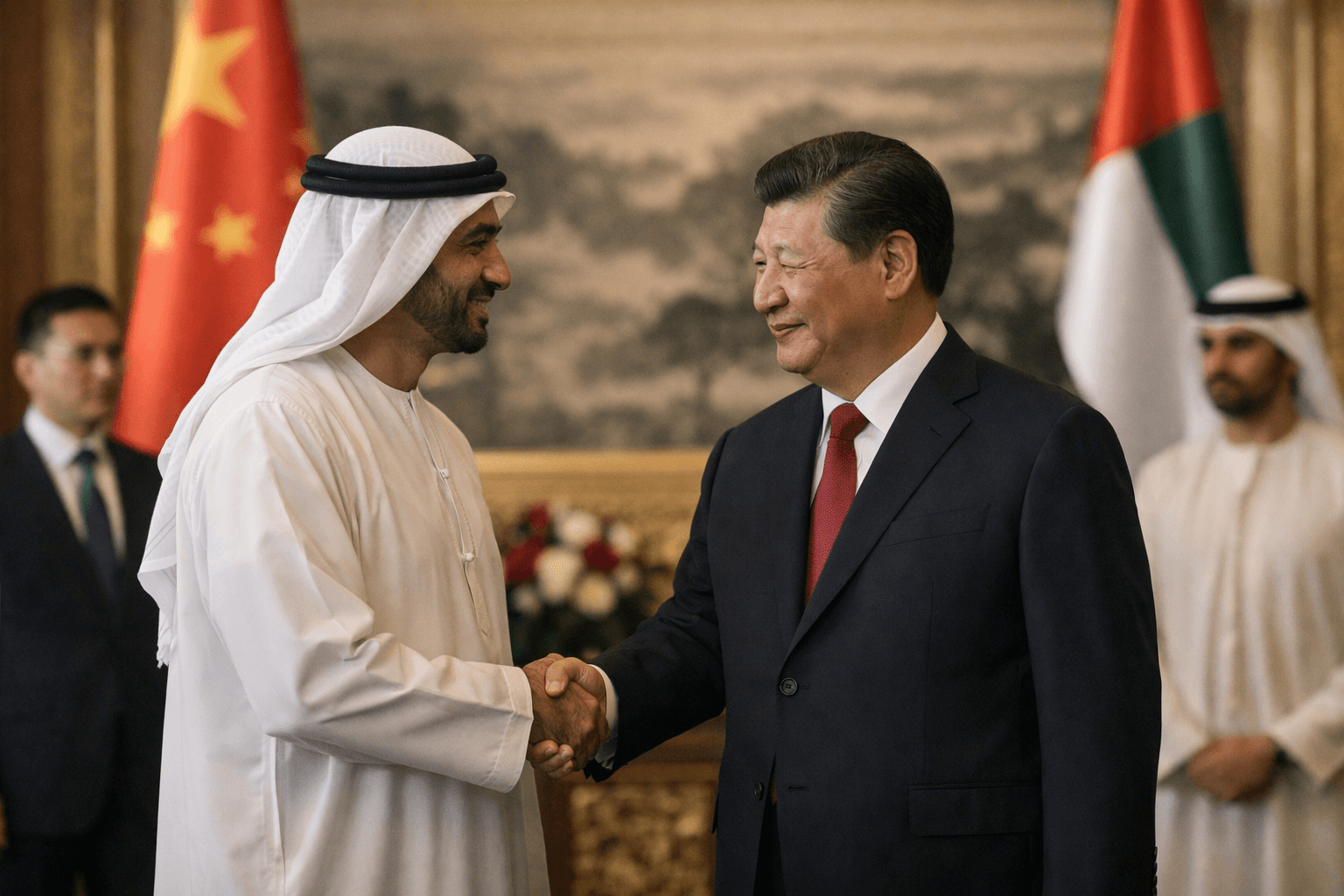
Rule of law Middle East messaging is becoming a central part of China’s diplomacy as President Xi Jinping publicly tied “international rule of law” to peace and stability in the region, in comments that Reuters described as a rebuke of the U.S.–Israel war on Iran. The practical consequence is immediate: Beijing is trying to shape the terms of any post-conflict negotiations while protecting its energy and trade interests, even as leader-level U.S.–China engagement is expected to resume in May.
What Xi said and when
Xi made the remarks on April 14, 2026, during a meeting in Beijing with UAE Crown Prince Sheikh Khaled bin Mohamed bin Zayed Al Nahyan, according to Reuters. Xi said the international rule of law must be upheld for peace and stability to prevail in the Middle East and criticized selective application of law.
Reuters reported that Xi’s framing amounted to an implicit criticism of the U.S.–Israel campaign against Iran. While China has repeatedly criticized the campaign, Reuters noted Xi has made relatively few public comments about the conflict compared with lower-level Chinese officials.
Why Beijing is elevating the “rule of law” frame
China’s emphasis on “international rule of law” serves multiple goals at once.
It sets a diplomatic narrative Beijing can repeat across forums
By centering legality and multilateral rules, Beijing can present itself as arguing for order rather than siding openly with any one party. That positioning is designed to travel: it can be repeated in bilateral meetings with Gulf states, in UN settings, and in China-led regional gatherings.
Reuters noted China plans to host a second China–Arab States Summit later this year. If that summit goes ahead, Beijing will have an additional stage to keep the legal framing at the center of any proposed ceasefire monitoring, reconstruction financing, or regional security discussions.
It creates leverage in sanctions and compliance debates
A “rule of law” posture also matters for the day-to-day question many companies and governments face during wars: what is legal, what is sanctioned, and what is enforceable. Beijing’s public line can be used to argue against measures it sees as unilateral or politically applied, including sanctions and secondary sanctions.
This matters because sanctions compliance is not abstract. It determines whether insurers underwrite shipments, whether banks clear payments, and whether traders and refiners can move cargoes without risking penalties.
It protects China’s energy and shipping exposure without overpromising
China has large energy interests tied to Middle East stability and maritime routes. But Beijing’s public messaging remains cautious: it can call for legal order and de-escalation without committing to security guarantees, military involvement, or specific enforcement mechanisms.
That restraint also reduces the risk of Beijing being held responsible for outcomes it does not control.
The U.S.–China calendar in the background
Reuters separately reported that U.S. President Donald Trump is planning a Beijing visit on May 14–15 for talks with Xi, after earlier timing was affected by the Iran war. In early April, U.S. Trade Representative Jamieson Greer said Trump would pursue stability with Xi in the May meeting and described the economic relationship as “stable,” while noting ongoing frictions such as tariffs and U.S. reliance on Chinese rare earths.
In that context, Xi’s Middle East “rule of law” remarks land as more than regional commentary. They signal the themes Beijing may want on the table—or at least in the room—when the two leaders meet: conflict risk, energy disruption, and the legitimacy of pressure tools like sanctions.
What to watch next
Three developments will indicate whether China’s positioning is turning into tangible leverage.
Whether Beijing attaches specific mechanisms to the rhetoric
So far, the public emphasis is on principles. A step-change would be China pushing concrete mechanisms—such as structured mediation formats, proposals tied to UN processes, or financial commitments that require defined legal protections.
How Gulf partners publicly respond
Xi made the remarks in a meeting with a senior UAE leader, and Reuters reported expanding China–UAE cooperation discussions. Watch for whether Gulf states echo the “international rule of law” phrase in their own readouts or joint statements, which would amplify Beijing’s framing.
Whether U.S.–China talks link geopolitics to economic tools
Trade and investment discussions can be influenced by geopolitical tensions through export controls, sanctions enforcement, shipping insurance constraints, and energy price volatility. Any indication that the May Xi–Trump meeting agenda blends these issues would be a sign the Middle East conflict is spilling directly into the economic relationship.
Why it matters for readers
This is not only about diplomatic language. When a major power uses “rule of law” as a headline frame during a war, it is also staking out a view on which rules count, who can enforce them, and which tools—sanctions, blockades, export controls—are legitimate. That affects governments deciding alignments, companies deciding compliance posture, and consumers who eventually pay for disruption through energy costs and supply chain delays.