
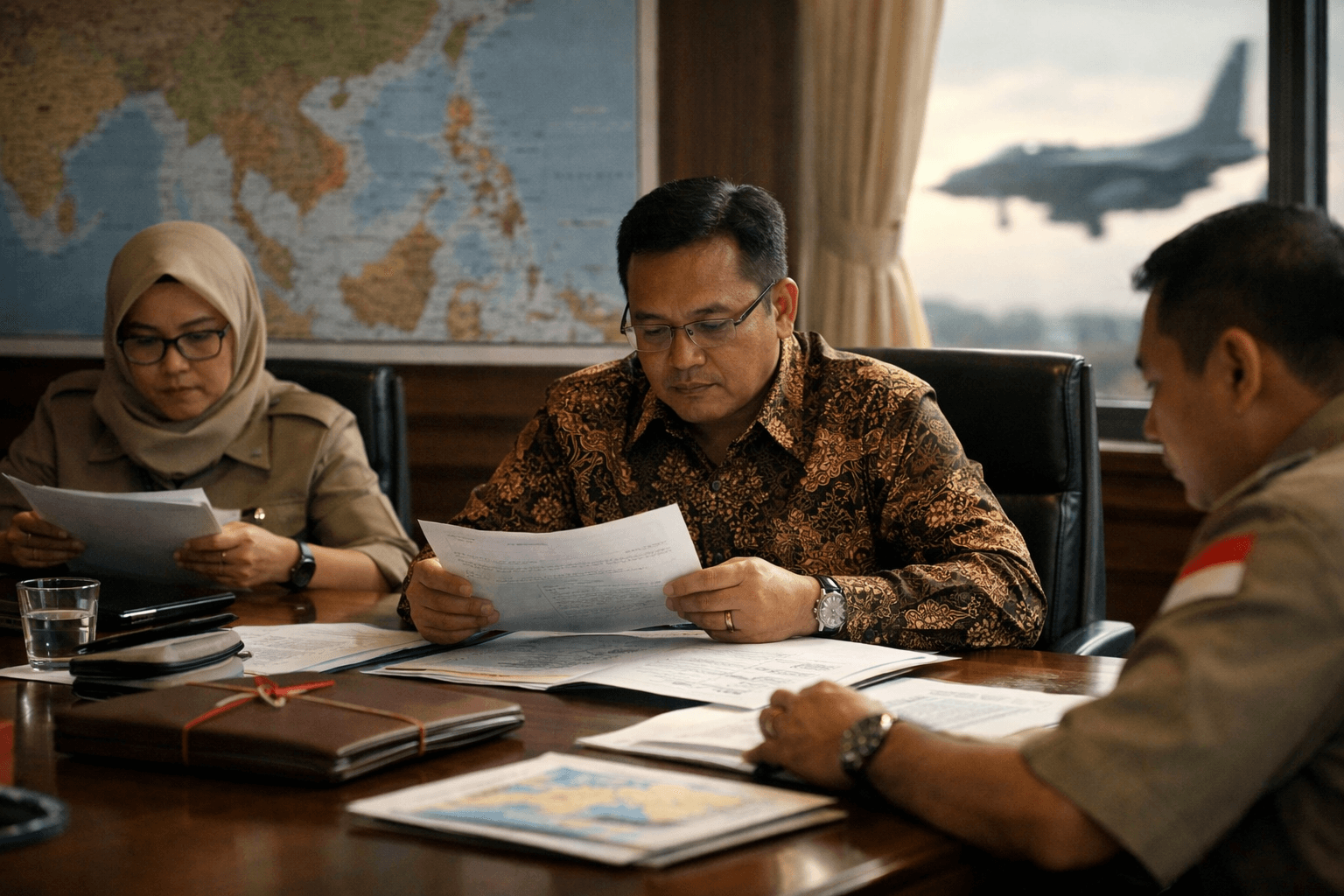
US military overflight proposal concerns surfaced inside Indonesia’s government after the foreign ministry urged the defence ministry to treat a U.S. request for broad airspace access with caution. The warning matters beyond paperwork: blanket overflight permissions can quickly reshape crisis-response options in the South China Sea and change how Indonesia is perceived by Beijing, Washington, and its Southeast Asian neighbors.
What Indonesia is warning about
Reuters reported that Indonesia’s foreign ministry sent an urgent letter to the defence ministry in early April 2026 raising serious concerns about a U.S. proposal seeking wide overflight rights across Indonesian territory. The letter, described by Reuters as confidential, warned that granting such permissions could entangle Indonesia in conflicts linked to the South China Sea and undercut Jakarta’s long-standing non-aligned posture.
The core issue is not routine diplomatic clearances for individual flights. It is the concept of “blanket” permissions—standing access that could reduce the need for case-by-case approvals when U.S. military aircraft transit Indonesian airspace for surveillance, reconnaissance, contingency operations, or exercises.
Where the proposal stands
A separate Reuters report a day earlier said the United States and Indonesia were discussing a draft arrangement that would provide U.S. military aircraft “blanket overnight access” to Indonesian airspace. Indonesia’s defence ministry said at the time that the document was still a preliminary draft under internal review and that there was no final, binding agreement.
That clarification was aimed at tamping down public assumptions that a deal had already been approved. It also underscored the domestic sensitivity: any perception that Indonesia has quietly granted privileged military access to a major power risks political pushback at home.
Why overflight rights become flashpoints
1) Crisis escalation risk is built into the mechanism
Overflight permissions change what is operationally easy. If standing access exists, military planners can route aircraft through Indonesian airspace during fast-moving events without waiting for ad hoc approvals. That speed advantage is precisely why overflight rights are valuable—and why they can become a regional flashpoint when tensions rise.
Indonesia’s foreign ministry, according to Reuters, flagged the risk that the proposal could drag Indonesia into South China Sea conflicts even if Jakarta does not intend to take sides.
2) Indonesia’s non-aligned brand is part of its leverage
Indonesia has tried to keep workable relations with both Washington and Beijing while defending its own maritime and airspace interests. Reuters noted President Prabowo Subianto has pursued balanced ties with the United States and China and has emphasized a non-aligned stance.
A broad overflight arrangement could be read—fairly or not—as a tilt. Even if it is framed as technical cooperation, rivals and partners may treat it as a signal about Indonesia’s strategic alignment.
3) China factor: relations and reactions
Reuters said the foreign ministry warned the agreement could negatively affect Indonesia’s relations with other regional partners, notably China. Indonesia’s geography makes this especially sensitive: it sits astride key routes near the South China Sea and around the Natuna area, where Indonesia has defended its interests amid overlapping maritime claims.
A standing U.S. overflight framework could prompt questions in Beijing about whether Indonesia is enabling expanded U.S. surveillance and patrol patterns. That can raise the temperature even if Indonesia’s intent is limited.
The sovereignty argument and past incidents
Indonesia’s defence ministry emphasized sovereignty over its airspace and said any arrangement would comply with Indonesian law, Reuters reported. That sovereignty frame is not abstract: it is the political foundation for approving or rejecting any special access.
Reuters also reported that the foreign ministry’s letter referenced past U.S. surveillance flights that allegedly violated Indonesian airspace without what the ministry viewed as an adequate U.S. response. That history matters because it shapes trust and raises the stakes of converting episodic clearances into a broader, standing permission.
What could happen next
If talks continue, the debate is likely to center on narrowness and control: the categories of flights covered, notification requirements, duration, and explicit carve-outs for sensitive areas. Mechanically, the more the proposal resembles case-by-case approvals with tight conditions, the less it functions as “blanket” access—and the easier it may be for Indonesian officials to defend domestically.
At the same time, the diplomatic calendar matters. Reuters reported that the proposal was expected to be tied to discussions around a meeting between Indonesia’s Defence Minister Sjafrie Sjamsoeddin and U.S. Defense Secretary Pete Hegseth, though it was unclear whether it was raised in that meeting.
Why readers should watch this story
The substance is technical, but the consequences are not. Overflight arrangements sit at the intersection of law, sovereignty, alliance signaling, and crisis behavior. A single line in an aviation or defence document can determine which routes are available when a regional confrontation breaks out.
For Indonesia, the test is whether it can deepen defence cooperation with the United States while keeping credible distance from great-power rivalry. For Washington, the question is whether it can secure meaningful access without forcing Jakarta into a political corner that triggers backlash—or invites retaliation in the region.