
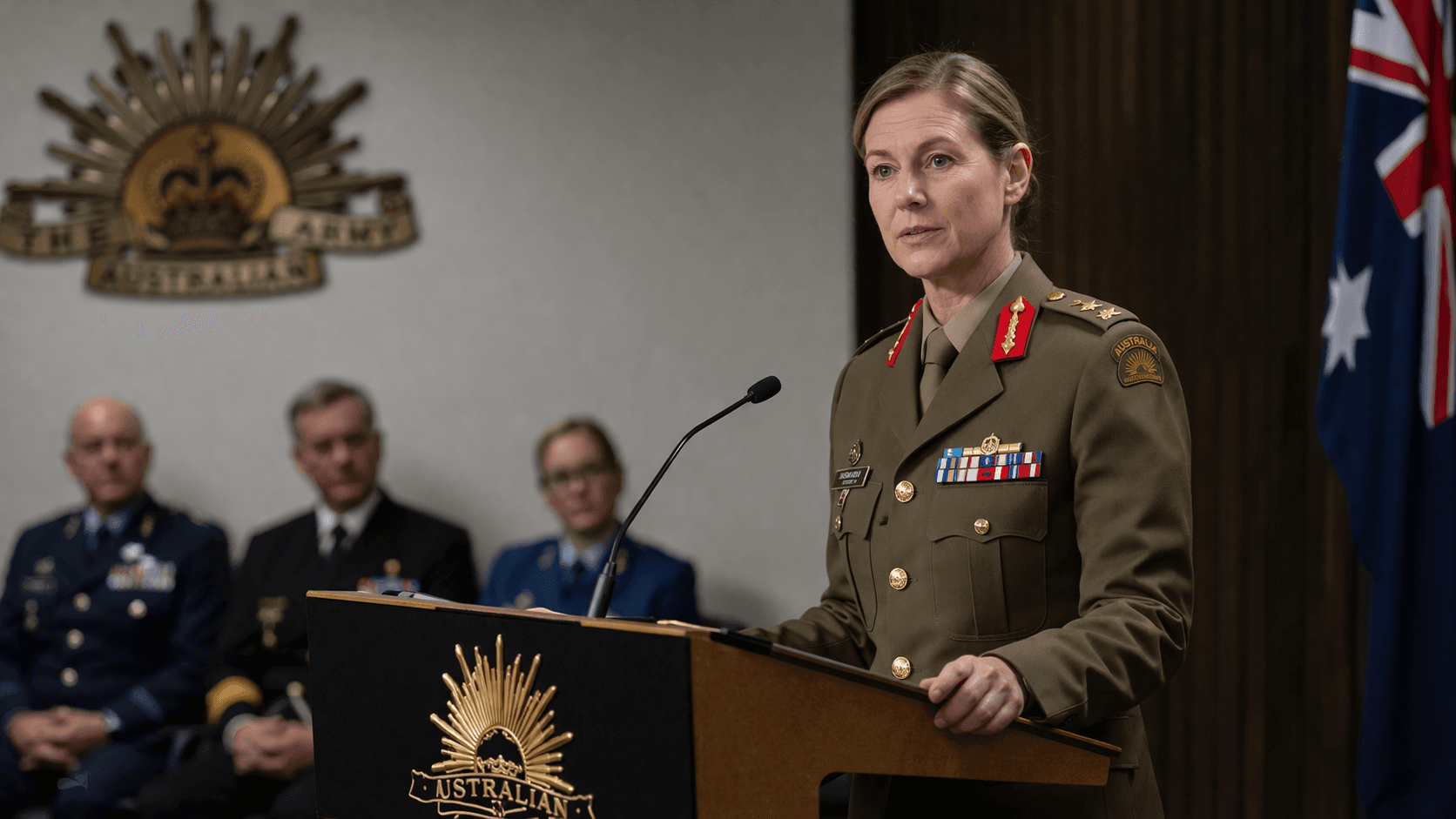
Susan Coyle Chief of Army is the Australian government’s headline Army appointment for a senior ADF leadership changeover due to take effect from July 2026, pending Governor-General approval. The move makes Lieutenant General Susan Coyle the first woman to command the Australian Army, and it lands at a time when Defence leaders are publicly prioritising force readiness and workforce pressure.
In the same package, Navy Chief Vice Admiral Mark Hammond is slated to become Chief of the Defence Force, while Rear Admiral Matthew Buckley is named as the next Chief of Navy. The government also confirmed the retirement of current Chief of Army Lieutenant General Simon Stuart and current Chief of the Defence Force Admiral David Johnston with the July change of command.
What the government announced
The Prime Minister and Defence Minister said the government will recommend several senior command appointments to the Governor-General, with the changes intended to take effect from July 2026. The appointments are to be presented to the Federal Executive Council as part of the statutory process.
Under the plan, Vice Admiral Mark Hammond AO RAN, currently Chief of Navy, will be appointed Chief of the Defence Force. Lieutenant General Susan Coyle AM CSC DSM, currently Chief of Joint Capabilities, will be appointed as Chief of Army. Rear Admiral Matthew Buckley AM CSC RAN will be appointed, on promotion, as Chief of Navy.
The government described the Army appointment as a national first, stating that Coyle will be the first woman in Australia’s history to command the Australian Army.
Who is Susan Coyle and what changes with the role
Lieutenant General Coyle is currently Chief of Joint Capabilities, a portfolio that sits across the services and includes capability areas that Defence has been highlighting as central to future operations, such as information warfare and other joint enablers.
In outlining her background, the government said Coyle enlisted in the Army Reserve in 1987 and has held command and leadership roles across tactical, operational and strategic levels. The roles cited include Head Information Warfare, Commander Forces Command, Commander Joint Task Force 633, Commander 6th Brigade, Commander Task Group Afghanistan and Commanding Officer 17th Signal Regiment.
The Chief of Army role is the senior professional head of the Australian Army. It is distinct from the Chief of the Defence Force role, which leads the Australian Defence Force as a whole. That separation matters in practice because the Chief of Army sets Army priorities, workforce posture and preparedness within the government’s direction and funding settings, while the Chief of the Defence Force carries overall accountability for Defence’s ability to generate and employ forces.
Why this appointment matters now
The leadership signal inside Defence
The Susan Coyle Chief of Army appointment is a major internal signal about who will be steering Army’s direction as the government implements its 2024 National Defence Strategy. The government explicitly linked the outgoing Army chief’s tenure to preparing the Army for changes required following that strategy, and the July 2026 handover sets a clean start point for the next phase of Army execution.
The cultural and workforce consequence
Making the first woman Chief of Army is not just symbolic inside a uniformed institution; it changes what is visibly possible in the promotion pipeline. In practical terms, it can influence recruitment and retention decisions where candidates weigh whether senior leadership reflects the force they are being asked to join and stay in.
That effect is not automatic, and it does not replace policy, training or accountability mechanisms. But the appointment is a concrete change in the leadership picture that will be visible across the force from July 2026.
The operational consequence
Coyle’s immediate consequence is not a new doctrine announcement; it is continuity and handover risk management. A service chief changeover reshapes decision flow, priorities and senior staff assignments, even when strategy is stable.
The government’s description of her experience places emphasis on command roles and information warfare leadership, which aligns with the broader Defence push toward operating in contested information and communications environments. The real-world test for Army will be whether leadership changes translate into measurable improvements in readiness and workforce stability under the constraints Defence faces.
The wider reshuffle: Hammond and Buckley
The government said Vice Admiral Mark Hammond will move from Chief of Navy to Chief of the Defence Force. It also said Admiral David Johnston will retire with the change of command in July 2026.
Rear Admiral Matthew Buckley was named as the next Chief of Navy. The government highlighted Buckley’s submarine service and his more recent work connected to nuclear submarine capability, positioning him to lead the Navy through major capability transitions.
What happens next and what is fixed in the timeline
The government framed these as recommendations to the Governor-General, with the statutory appointments to be presented to the Federal Executive Council. The intended start point is July 2026.
One major role is explicitly unresolved: the government said the next Chief of Joint Capabilities, the job Coyle currently holds, will be appointed “in due course.” That vacancy is a concrete follow-on decision because Joint Capabilities underpins cross-service functions that affect the Army, Navy and Air Force simultaneously.
For the public, the near-term takeaway is straightforward: Susan Coyle Chief of Army is set for July 2026, with Simon Stuart retiring at the change of command, as the government also turns over the top ADF post from David Johnston to Mark Hammond and hands Navy leadership to Matthew Buckley.