
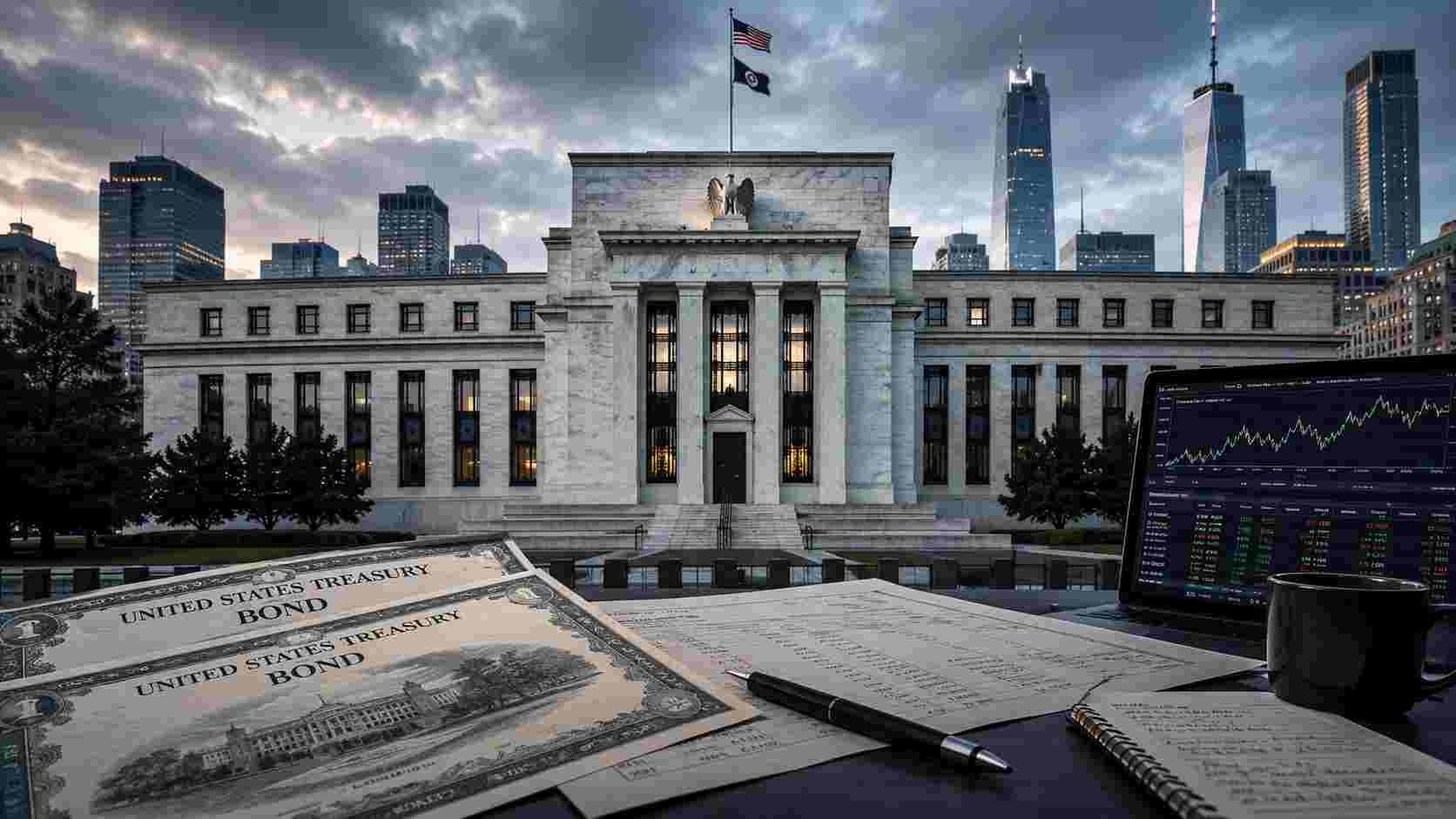
Fed hold consensus is no longer a clean story of waiting for cuts. The Federal Reserve kept the federal funds target range at 3.5 percent to 3.75 percent at its April 28–29, 2026 meeting, but the minutes released on May 20 showed a more divided policy backdrop.
The immediate consequence is not an official rate increase. It is a tightening in financial conditions as investors reprice the path of rates, push long-term yields higher, and question whether the next meaningful move could be up rather than down.
Context
For much of the earlier rate cycle, investors treated the Fed’s pause as a bridge toward eventual easing. That assumption has weakened as inflation stayed above the Fed’s 2 percent goal and global energy prices rose after developments in the Middle East.
The April statement said economic activity had expanded at a solid pace, while job gains remained low on average and unemployment was little changed. It also said inflation was elevated, partly because of higher global energy prices, and that Middle East developments were adding uncertainty.
The policy split matters because three members supported holding rates but opposed what they saw as an easing bias in the statement. One member preferred a 25 basis-point cut. That combination left the Fed formally on hold but less united about whether the next signal should lean toward easing.
Mechanism
The mechanism is straightforward. If investors believe inflation will remain sticky, they demand more compensation to hold longer-dated bonds. That lifts Treasury yields even before the Fed changes its policy rate.
Higher long yields feed directly into mortgage rates, corporate borrowing costs, credit spreads, and valuation math for equities. They also raise the government’s cost of financing new debt and refinancing maturing obligations.
The Fed’s own language leaves room for a policy shift. The April statement said, “The Committee would be prepared to adjust the stance of monetary policy as appropriate if risks emerge that could impede the attainment of the Committee’s goals.” That sentence is deliberately broad enough to cover either cuts or hikes.
Stakeholders
The first pressure point is households. Higher long-term rates make mortgages, auto loans, and credit-card refinancing more expensive, which can cool spending without a formal Fed hike.
Companies face a similar squeeze. Businesses that need to borrow, refinance, or sell debt into the market must pay more when Treasury yields rise, especially if investors also demand wider credit spreads.
The Treasury is another stakeholder. Sustained higher yields increase federal debt-service costs and reduce fiscal room for other priorities. Investors, meanwhile, must decide whether bonds now offer better income or still carry too much inflation risk.
Data and Evidence
The FOMC minutes said a majority of participants believed some policy firming would likely become appropriate if inflation continued to run persistently above 2 percent. They also noted that holding rates steady would allow the committee to gather more information on how Middle East developments and other factors were affecting the outlook.
The Treasury’s daily par yield curve data for May 22, 2026 showed yields rising across the curve compared with earlier in the month. The published data put the 10-year par yield at 3.64 percent and the 30-year par yield at 3.85 percent on May 22.
Reuters reported on May 22 that Nomura no longer expected Fed rate cuts in 2026, reversing earlier expectations for two 25 basis-point cuts. Reuters also reported that futures pricing had moved toward a non-trivial probability of a rate increase by year-end.
Financial Times reporting on May 24 said higher Treasury yields, if sustained, could add billions of dollars to U.S. interest costs, linking the bond-market move to fiscal pressure rather than only to monetary-policy expectations.
Analysis
The strongest explanation is that markets are treating inflation risk as a live constraint again. The Fed can hold the policy rate steady, but if investors believe energy prices, geopolitical risk, or demand resilience will keep inflation elevated, the bond market can tighten conditions on its own.
That is why the story is bigger than a single meeting. The Fed has not announced a hike, but its minutes show that a majority saw policy firming as plausible if inflation remains above target. That changes how investors read every inflation print, labor-market release, and oil-price move.
The shift also weakens the idea that a pause automatically means relief for risk assets. Equities can benefit from solid growth, but higher discount rates make future earnings less valuable today. Housing is even more directly exposed because mortgage pricing is tied closely to longer-term yields.
Counterpoint
The case for cuts has not disappeared. One FOMC member voted for a 25 basis-point reduction, citing concern that policy was too restrictive given downside labor-market risks.
There is also uncertainty around the energy shock. If global energy prices stabilize or fall, inflation pressure could ease and the Fed could regain room to cut later. A slower labor market would also change the balance of risks.
The key point is that the market debate has become two-sided. Cuts are no longer the only serious path under discussion, and the Fed’s own minutes support that change in interpretation.
Consequence
The consequence is tightening without a new policy move. Long-term yields can rise, credit can become more expensive, and fiscal costs can increase while the Fed still officially says it is holding steady.
That creates a difficult policy mix. If the Fed cuts too early, inflation expectations could become harder to control. If it holds too long or later hikes, the pressure on housing, credit, equities, and federal debt service could intensify.
What to Watch
The next scheduled FOMC meeting is June 16–17, 2026. Investors will watch whether officials remove language that markets read as an easing bias and whether more members publicly describe hikes as a possible response to persistent inflation.
The most important data points are inflation readings, inflation expectations, labor-market conditions, oil prices, and Treasury auctions. The central question is whether the Fed can keep policy on hold without the bond market doing more of the tightening itself.
Sources
Minutes of the Federal Open Market Committee, April 28–29, 2026 — Board of Governors of the Federal Reserve System — May 20, 2026 Federal Reserve Issues FOMC Statement — Board of Governors of the Federal Reserve System — April 29, 2026 Daily Treasury Par Yield Curve Rates — U.S. Department of the Treasury — May 22, 2026 Fed's Waller ready to axe easing bias, though not advocating rate hikes yet — Reuters — May 22, 2026 Nomura pivots away from Fed rate cuts in 2026 as inflation risks linger — Reuters — May 22, 2026 Iran war could add billions of dollars in interest payments to US debt — Financial Times — May 24, 2026