
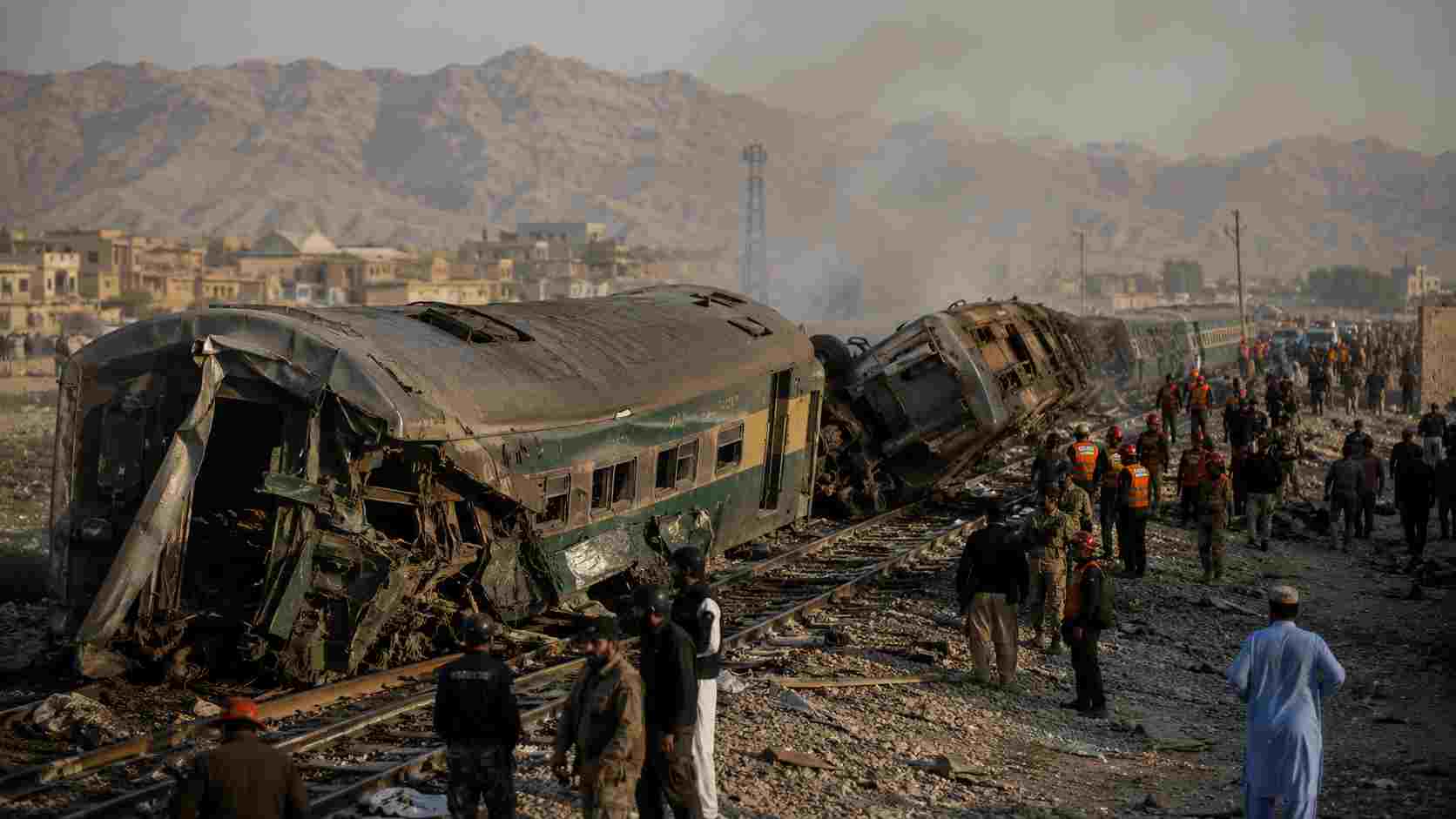
Pakistan train bombing in Quetta killed at least 24 people on May 24, 2026, after a blast struck a shuttle train in Balochistan, according to Reuters reporting based on officials.
The attack hit a train linked to the Jaffar Express route and wounded about 70 people, Reuters reported. The Associated Press reported at least 23 people killed and more than 70 wounded after a suicide bomber detonated explosives near a railway track as a train passed.
The Baloch Liberation Army, a separatist militant group, claimed responsibility, according to Reuters and AP. Officials said the train was carrying Pakistani security personnel and family members, making the attack both a mass-casualty event and a direct strike on transport used by the state.
Context
Balochistan is Pakistan’s largest province by area and has long faced a separatist insurgency rooted in disputes over political control, resources, security operations and local representation.
The province borders Iran and Afghanistan and includes strategic transport corridors, energy routes and mineral assets. That makes attacks on railways and other infrastructure especially sensitive for Pakistan’s government and security establishment.
The BLA has claimed previous attacks on security forces, transport targets and state-linked infrastructure. Reuters reported that the May 24 attack followed a string of violent incidents in the province, including the 2025 hijacking of the Jaffar Express.
Mechanism
Reuters reported that the blast targeted a shuttle train carrying Pakistani security personnel and their families from Quetta’s cantonment area to link with the Jaffar Express.
AP described the attack as a suicide bombing near a railway track in Quetta. Reuters reported that the explosion derailed the train’s engine and three coaches, with two coaches overturning.
The practical effect was to turn a routine transport movement into a high-casualty target. A railway line is difficult to secure continuously because tracks pass through open areas, neighborhoods and remote stretches where surveillance and rapid response can be uneven.
Stakeholders
The immediate victims were passengers, security personnel, family members and nearby residents affected by the blast and rescue operations.
Pakistan’s federal government and Balochistan’s provincial authorities face pressure to show that rail routes, cantonment-linked movements and urban transport corridors can be protected. Hospitals and emergency services in Quetta also carried the first burden after dozens of casualties arrived.
The BLA benefits tactically from visibility when an attack disrupts a state-linked route and draws national attention. But the group also faces the political risk that mass casualties, especially where families or civilians are among the dead or injured, deepen public anger rather than support.
Data and Evidence
Reuters reported at least 24 people killed and around 70 injured. AP reported at least 23 killed and more than 70 wounded.
Both accounts identified Quetta, the capital of Balochistan, as the location and reported that the BLA claimed responsibility. Reuters said the train was a shuttle linked to the Jaffar Express, while AP said the attacker detonated explosives near a railway track as the train passed.
Reuters also reported physical damage to the train, including a derailed engine and coaches. AP reported that two cars overturned and caught fire.
The casualty numbers remained slightly different across early reports, which is common after large attacks as hospitals, police and rescue agencies update counts. The confirmed baseline is that more than 20 people were killed and dozens were wounded.
Analysis
The strongest explanation is that the attack was designed to pressure Pakistan’s security apparatus by hitting a transport movement associated with military or security personnel while also creating wider public fear around rail travel.
That matters because railways are both practical infrastructure and political symbols. They connect provinces, move workers and families, and show whether the state can maintain normal movement through contested territory.
The attack also signals that militants can still carry out complex or high-impact violence in an urban area despite counterinsurgency pressure. Even when a group cannot hold territory, it can damage confidence by making ordinary routes feel unsafe.
Counterpoint
Early reporting does not establish every operational detail of the attack. Officials and news agencies reported a suicide bombing and a BLA claim, but investigators may still need to determine the exact explosives used, the attacker’s route, security gaps and whether accomplices were involved.
There is also a distinction between the attacker’s claimed target and the real human impact. The BLA said it targeted security-linked passengers, according to reporting, while Pakistani officials accused militants of harming innocent people. Both points shape how the attack will be understood politically.
Consequence
The immediate consequence is likely tighter security around railway movements in and around Quetta, especially trains carrying security personnel or passing near cantonment-linked areas.
The broader consequence is a renewed perception of risk around transport corridors in Balochistan. For residents, that means more checkpoints, delays and fear during routine travel. For the state, it means more pressure to secure long stretches of infrastructure without shutting down daily movement.
The attack may also harden official responses toward Baloch separatist groups, particularly if authorities link it to a wider pattern of attacks on transport and security personnel.
What to Watch
Watch whether Pakistan Railways changes schedules, suspends routes or increases security around trains linked to Balochistan.
Also watch for updated casualty figures from hospitals and officials, because early numbers often change after severe blasts. Investigators’ findings on how the bomber reached the track area will be central to understanding whether the attack exposed a local security failure or a broader intelligence gap.
The next political test will be whether the federal and provincial governments can reassure passengers without turning rail travel into a heavily militarized experience for ordinary people.
Sources
At least 24 killed in Pakistan train blast claimed by separatist militants — Reuters — May 24, 2026
A suicide bombing near a railway track in southwest Pakistan kills at least 23 people — Associated Press — May 24, 2026